

FI-SP-00200 | 'El Almirante y el Mar Océano' Cristóbal Colón
Some designs begin with modern trends. Others reach backward into the turning points that reshaped the world. “El Almirante y el Mar Océano” belongs firmly to the latter. This piece draws from the historical figure of Cristóbal Colón and the era of transatlantic exploration that marked the end of the medieval world and the beginning of the early modern age. The design is not intended as a romanticized retelling, but as a visual artifact rooted in the imagery, symbolism, and language of the late 15th century.
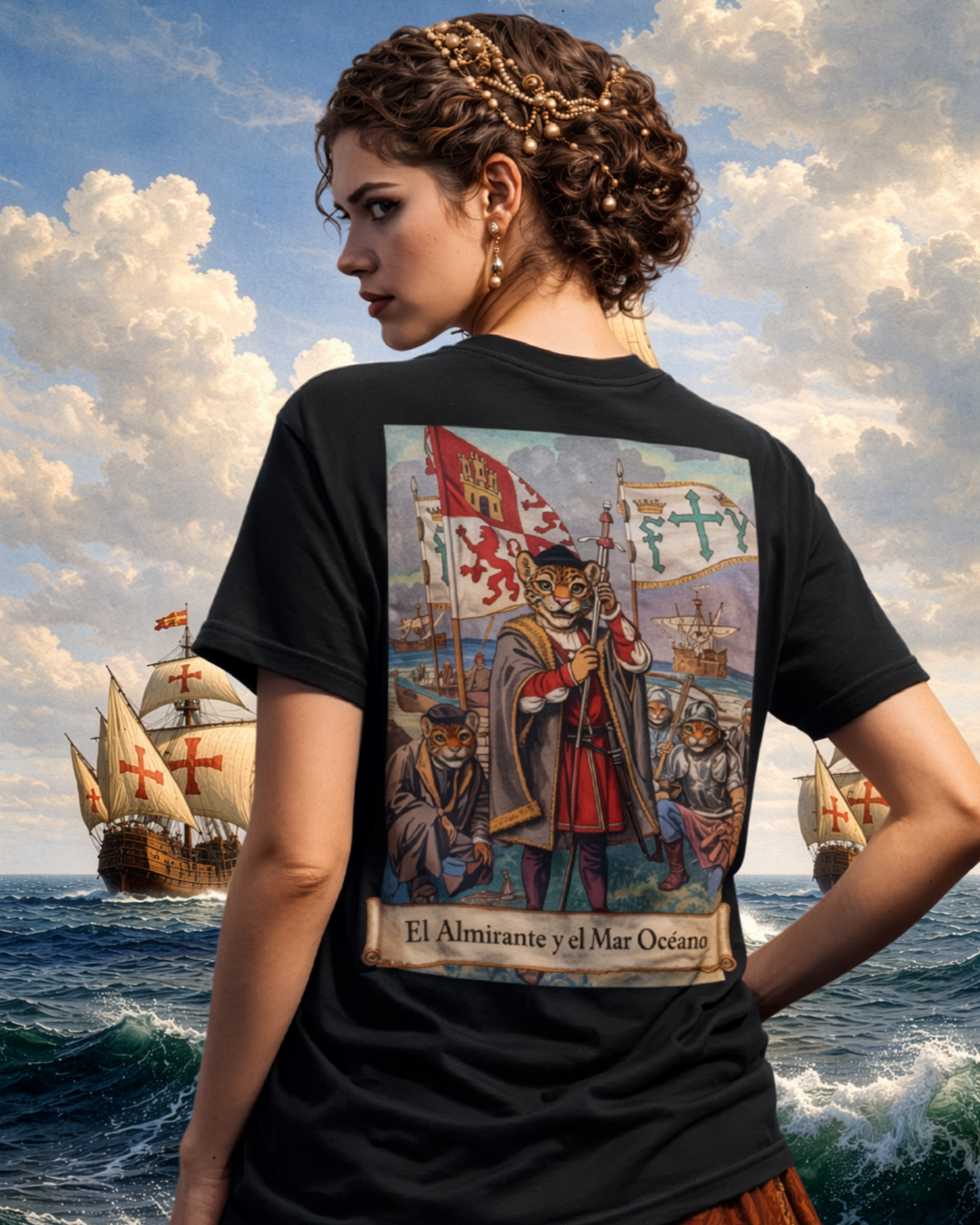
At the center of the graphic stands a stylized admiral figure inspired by period depictions of Columbus. He holds a standard, surrounded by maritime banners and ships that echo the iconography of Iberian exploration. The title itself, El Almirante y el Mar Océano, references a historically grounded phrase. Columbus was granted the hereditary title Admiral of the Ocean Sea (Almirante del Mar Océano) by the Catholic Monarchs of Spain, Ferdinand II of Aragon and Isabella I of Castile, under the Capitulations of Santa Fe in 1492. The phrase reflects both rank and worldview: to late medieval Europe, the Atlantic was not yet a mapped highway but an immense and uncertain frontier.
The ships represented in the composition draw visual lineage from the vessels associated with the first voyage of 1492: the Niña, the Pinta, and the Santa María. While stylized for the sake of composition, their inclusion reflects a real maritime tradition. Iberian caravels and carracks were products of centuries of Mediterranean and Atlantic shipbuilding knowledge, blending lateen and square sails to allow navigation across open oceans. These ships made sustained transoceanic travel possible, fundamentally altering global trade routes and cultural exchange.
Equally important to the design is the language. The Spanish title is not decorative. It anchors the piece within its historical context. Late 15th-century Castilian Spanish carried formal titles and ecclesiastical overtones that reflected the deeply intertwined nature of monarchy, religion, and exploration. Columbus sailed not only as a navigator but as a representative of the Spanish Crown and Christian expansion, a reality reflected in period documents, flags, and insignias.
The cultural weight of Columbus’s voyages is complex and widely debated today. Historically, the 1492 expedition initiated sustained contact between Europe and the Americas, setting off what scholars call the Columbian Exchange. This era reshaped ecosystems, economies, and civilizations across continents through the movement of crops, animals, diseases, technologies, and peoples. Any artifact referencing this period carries that layered historical gravity, and the design acknowledges this by leaning into archival visual language rather than modern reinterpretation.
Visually, the composition mirrors the structure of illuminated manuscripts and early exploration engravings. The central figure framed by banners and ships evokes the narrative style of early modern European prints, where explorers were presented in symbolic rather than purely realistic form. This approach preserves the feeling of historical storytelling, where myth, politics, and documentation often blurred together in a single image.
The decision to keep the focus tightly on the admiral motif reinforces the conceptual vision of the piece. Rather than depicting a specific event or location, the design captures an archetype: the navigator at the edge of the known world. It reflects the mentality of the Age of Discovery, when maps ended in uncertainty and the ocean represented both opportunity and danger. In this way, the shirt functions less as a literal illustration and more as a visual emblem of an era defined by movement and transformation.
“El Almirante y el Mar Océano” ultimately exists as a wearable archive. It draws from verified titles, maritime history, and period language to build a composition rooted in documented cultural memory. By grounding the design in real historical references while presenting them through a stylized lens, the piece bridges past and present, transforming a pivotal chapter of world history into a graphic form that preserves its depth, symbolism, and enduring resonance.

Comments