
FI-MX-00100 | 'Polvo y Plomo' Mexican Revolution Pancho Villa
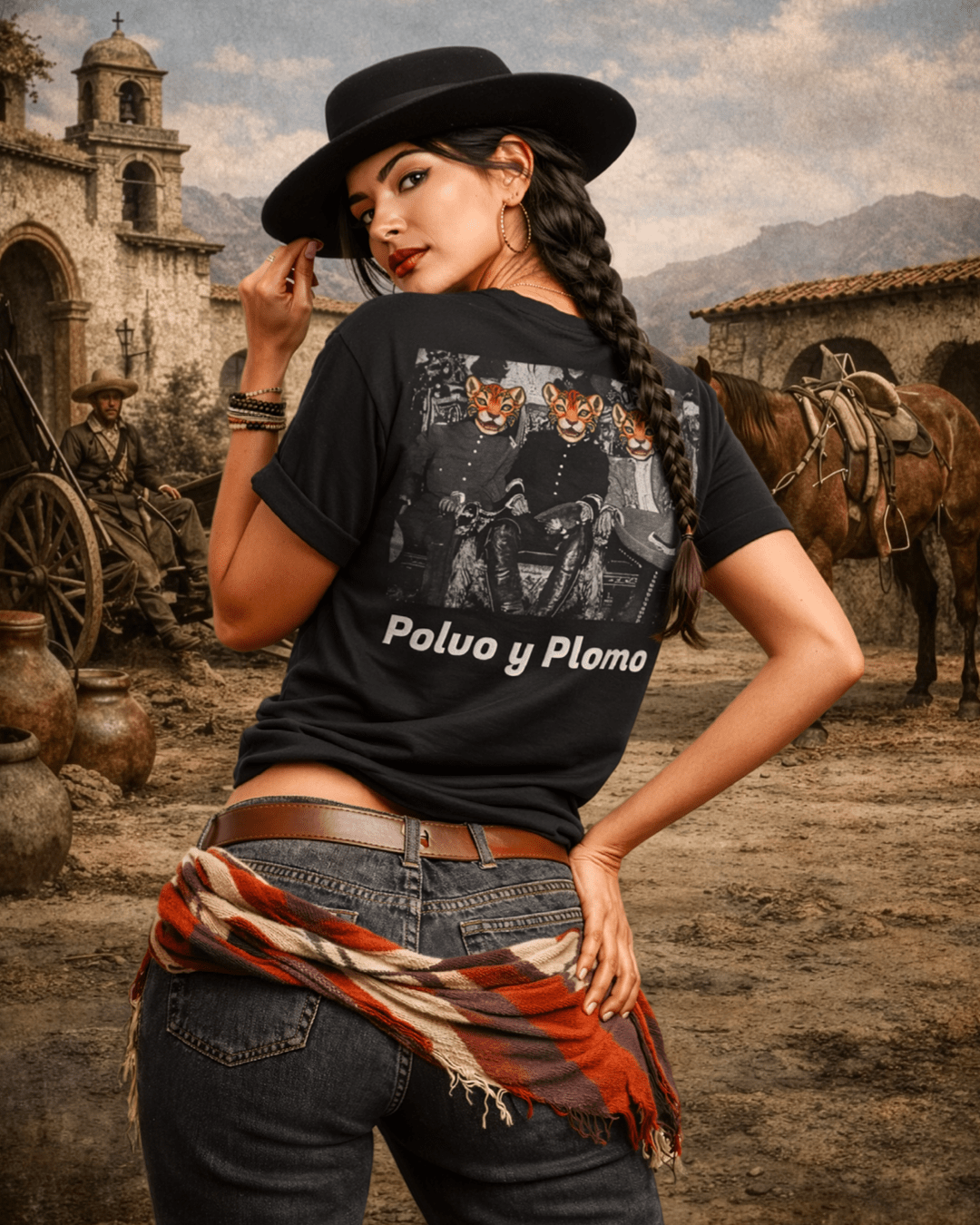
Some images are tied to a single moment. Others belong to an era. The visual language behind the “Polvo y Plomo” design draws from the dust-choked battlefields and restless frontiers of the Mexican Revolution, a conflict that reshaped Mexico between 1910 and 1920. Rather than recreating one documented photograph, the graphic captures a broader historical truth: the world of the northern revolutionary fighter, where survival was measured in miles ridden, cartridges spent, and the thin line between rebellion and legend.
The figures in the image are best understood as archetypal Villistas, the soldiers who fought under the command of revolutionary leader Pancho Villa. These men were not career soldiers in the traditional sense. Many were vaqueros, miners, ranch hands, and laborers drawn into the conflict by inequality and instability during the final years of Porfirio Díaz’s long rule. Their clothing reflected that origin: wide sombreros for sun and dust, bandoliers crossing the chest, and practical frontier garments suited for life on horseback. This was not theatrical costuming. It was the uniform of a rural uprising.
Pancho Villa himself became one of the most recognizable figures of the revolution, not only within Mexico but internationally. His División del Norte operated largely across the northern states of Chihuahua and Durango, where the terrain shaped both strategy and identity. Warfare in this region was highly mobile. Armies moved quickly across deserts and rail lines, capturing towns, abandoning them, and reappearing miles away. Because of this constant motion, many of the most enduring revolutionary images are not of grand battles but of quieter, tense pauses between them, moments where fighters regrouped, watched the horizon, and prepared for whatever came next.
The phrase “Polvo y Plomo,” translated as “Dust and Lead,” is not a documented slogan from the period, but it reflects a historically accurate emotional landscape. Dust defined the geography of the northern campaigns, coating riders, towns, and weapons alike. Lead defined the reality of the revolution itself, a prolonged struggle fought with rifles, ammunition belts, and the ever-present threat of violence. Together, the phrase captures a lived atmosphere rather than a literal quote, a poetic shorthand for the physical and psychological terrain of revolutionary life.
While the Mexican Revolution contained many competing ideologies, the fighters associated with Villa were often driven less by formal political theory and more by immediate realities: land inequality, economic exclusion, and resistance to centralized power. The long rule of Porfirio Díaz had modernized Mexico in visible ways, but it also concentrated land and wealth into the hands of a small elite. For many rural northerners, joining a revolutionary column was not about abstract ideology but survival, dignity, and the possibility of a different future.
The posture suggested in the image reflects this lived reality. The figures appear composed yet alert, relaxed but armed, evoking the in-between spaces of revolution rather than staged celebration. These were men who existed in motion, riding from town to town, never fully at rest. In historical accounts, revolutionary fighters often spent more time waiting than charging: waiting for supplies, waiting for orders, waiting for dust clouds on the horizon that might signal allies or enemies alike. That suspended tension became part of the revolution’s visual identity.
Over time, Pancho Villa’s image evolved into something larger than the man himself. To some, he was a bandit. To others, a folk hero. To international audiences, he became a symbol of the untamed frontier, amplified by early 20th-century newspapers and film crews that followed his campaigns. This blending of reality and myth is part of why revolutionary imagery still resonates today. It occupies a rare space where documented history and cultural memory overlap, forming an enduring visual language that continues to inspire art, storytelling, and design.
The “Polvo y Plomo” piece exists within that space. It does not attempt to reconstruct a museum artifact or replicate a specific archival photograph. Instead, it draws from the shared visual memory of the northern revolution: dust rising behind cavalry columns, ammunition belts catching the sun, and figures forged in a landscape where identity was shaped by motion and conflict. By focusing on atmosphere rather than literal documentation, the design connects to the emotional core of the era while remaining rooted in real historical conditions.
In that sense, the image reflects the broader legacy of the Mexican Revolution itself. It was a conflict defined not only by its leaders or battles but by the ordinary people pulled into its orbit. Farmers became soldiers. Riders became symbols. Dust became history. The revolution left behind more than political change. It left an enduring cultural imprint, carried forward through memory, myth, and the stories still told about those who lived between dust and lead.
Comments