
FI-JP-00100 | 47 Rōnin Historical Battle Ukiyo-e
Some designs chase aesthetics. Others inherit memory.
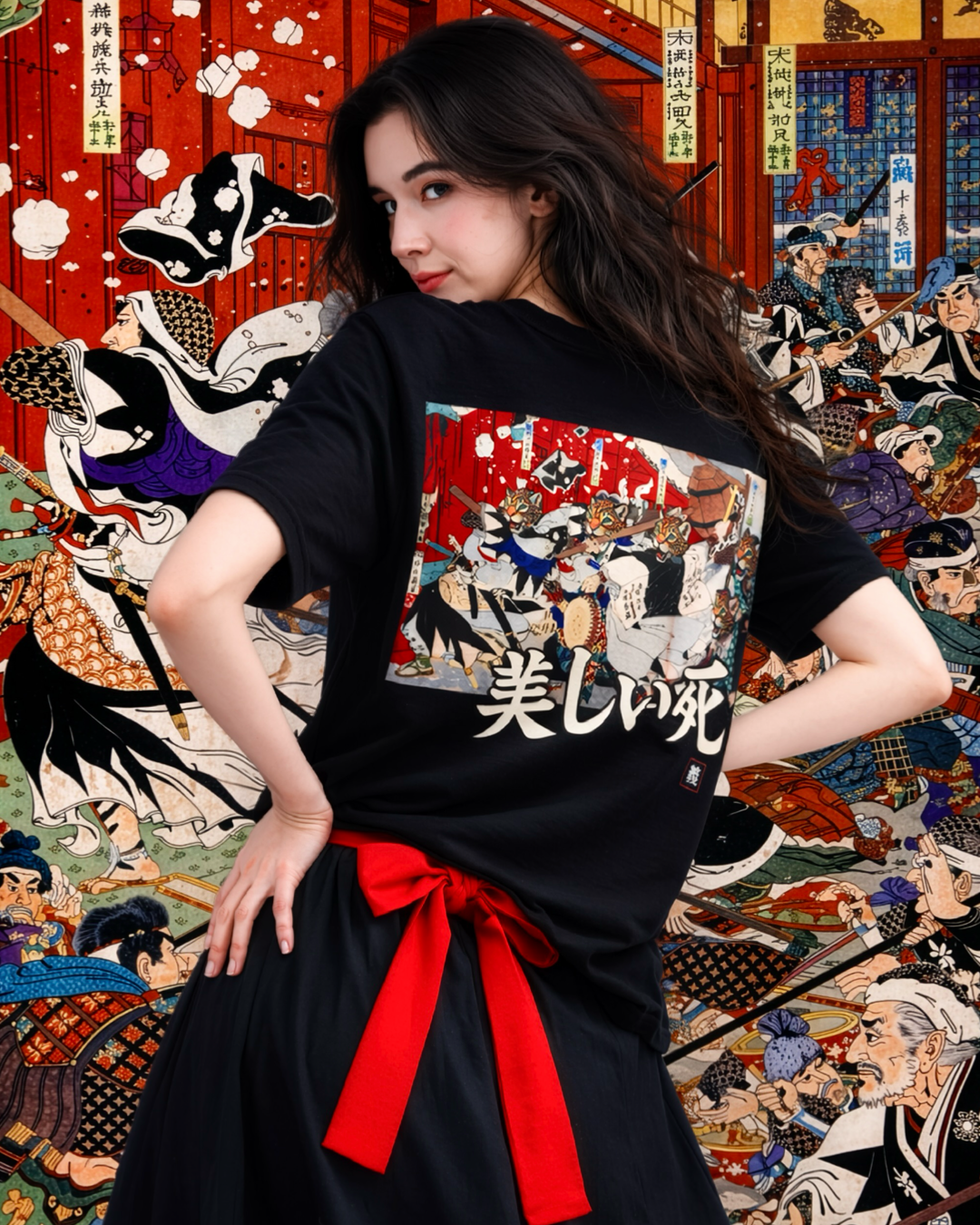
The 47 Rōnin Historical Battle Ukiyo-e piece belongs firmly to the latter. This design draws from one of the most enduring stories in Japanese history: the legend of the Forty-Seven Rōnin, a tale of loyalty, sacrifice, and moral duty that has shaped Japanese cultural identity for more than three centuries.
At the center of the shirt is a battle composition inspired by traditional ukiyo-e woodblock prints of the Edo period. The layout, palette, and movement reflect the visual language popularized by artists such as Utagawa Kuniyoshi, whose 19th-century prints helped immortalize the rōnin story in mass visual culture. Rather than reimagining the narrative, the design preserves the layered density typical of historical ukiyo-e: multiple figures in motion, compressed perspective, and vivid contrasts of red, ivory, and ink black. It is not minimal by accident. Edo storytelling was rarely quiet.
The Historical Foundation: The Akō Incident
The cultural backbone of this piece is the real historical event known as the Akō Incident (1701–1703). The story begins with Asano Naganori, a young daimyō ordered to perform ceremonial duties in Edo. After a prolonged conflict with court official Kira Yoshinaka, Asano attacked him inside Edo Castle, an unforgivable breach of protocol. Asano was ordered to commit seppuku, and his domain was dissolved, leaving his samurai masterless. They became rōnin.
What followed became legend. Under the leadership of Ōishi Kuranosuke, forty-seven former retainers spent nearly two years waiting, planning, and concealing their intent. In December 1702, they launched a coordinated night attack on Kira’s estate, killed him, and delivered his head to their former lord’s grave at Sengaku-ji Temple. They then surrendered and were themselves ordered to commit seppuku.
The act was controversial even in its own time. It violated the law, yet embodied an ideal of bushidō: loyalty beyond life. That tension is precisely why the story endured.
From History to Cultural Myth
While the Akō Incident was real, its transformation into cultural mythology came later through theater and print. During the Edo period, censorship laws prevented direct dramatizations of recent political events. Artists and playwrights adapted the story into fictionalized forms, most famously the kanbun-era puppet and kabuki play Chūshingura. By disguising names and timelines, creators could explore the moral themes without triggering political backlash.
This reinterpretation fueled a massive wave of artistic output. Ukiyo-e artists produced serialized print sets depicting the rōnin in dramatic poses, battle formations, and pre-attack rituals. These prints were not merely decorative. They functioned as early popular media, shaping how ordinary people understood loyalty, justice, and honor.
The shirt’s visual density intentionally echoes this era of storytelling, where imagery served as both documentation and myth-making.
The Role of Ukiyo-e in Memory Preservation
Ukiyo-e, often translated as “pictures of the floating world,” was never limited to courtesans and landscapes. It was a democratic medium. Woodblock prints could be reproduced and distributed widely, allowing historical narratives like the 47 rōnin to circulate across social classes.
Artists such as Kuniyoshi became synonymous with warrior imagery. His prints emphasized exaggerated motion, expressive armor details, and layered compositions filled with tension. The influence of that visual tradition is central to this design’s structure. The framing mimics archival print panels, preserving the sensation of looking into a historical plate rather than a modern illustration.
By drawing directly from ukiyo-e compositional principles, the shirt avoids stylization that would detach it from its source lineage. It stays visually anchored to the period that first immortalized the story in mass culture.
Symbolism Embedded in the Design
The visual chaos of the battle scene is deliberate. Ukiyo-e depictions of the rōnin often focused on the moment of confrontation, when patience gave way to action. That tension between restraint and release mirrors the historical narrative itself: two years of silence, followed by one decisive night.
The typography and layout remain restrained to allow the artwork to carry historical weight. Rather than overwhelming the composition with modern graphics, the design preserves the integrity of the original storytelling structure. This aligns with how Edo-era prints functioned: image first, commentary second.
In this way, the shirt does not reinterpret the legend through a contemporary lens. It preserves the cultural memory encoded in the original visual language.
Cultural Resonance Beyond Japan
The legend of the 47 rōnin has endured because it exists at the intersection of history and philosophy. In Japan, it remains a touchstone for discussions about duty, honor, and collective loyalty. Sengaku-ji Temple, where the rōnin are buried, continues to receive visitors and annual commemorations more than 300 years later.
Internationally, the story has crossed mediums and centuries, influencing literature, film, theater, and art. Yet ukiyo-e remains the most historically authentic visual form through which the narrative spread. That is the lineage this design consciously pulls from. Not cinematic reinterpretations, but the earliest mass-visual storytelling that carried the legend into cultural permanence.
The Vision Behind the Piece
The intent behind the 47 Rōnin Historical Battle Ukiyo-e design is preservation rather than reinvention. The goal is not to modernize the legend, but to translate a historically rooted visual tradition into a contemporary wearable form without stripping away its context.
By maintaining the compositional density, period-correct visual cues, and ukiyo-e framing, the design functions as a bridge between eras. It allows a centuries-old narrative to exist within modern streetwear while remaining anchored in verified historical events and documented artistic traditions.
This approach reflects a broader philosophy: treating cultural history not as aesthetic inspiration alone, but as a living archive that can be carried forward through careful translation.
A Story That Refuses to Fade
More than three centuries after the Akō Incident, the 47 rōnin remain embedded in Japan’s cultural consciousness. Their story survives because it exists in contradiction: lawful yet rebellious, tragic yet honorable, historical yet mythic.
Ukiyo-e ensured that memory would not remain confined to written records. It gave the legend a visual permanence that could be reproduced, collected, and passed through generations. This design continues that lineage in a different medium, carrying forward the same narrative through fabric instead of woodblock.
Not an adaptation. A continuation of the archive.
Comments