
When Culture Stopped Being Lived: Did the Loss of Ancient Cultural Structure Shape Today’s World of Isolation?
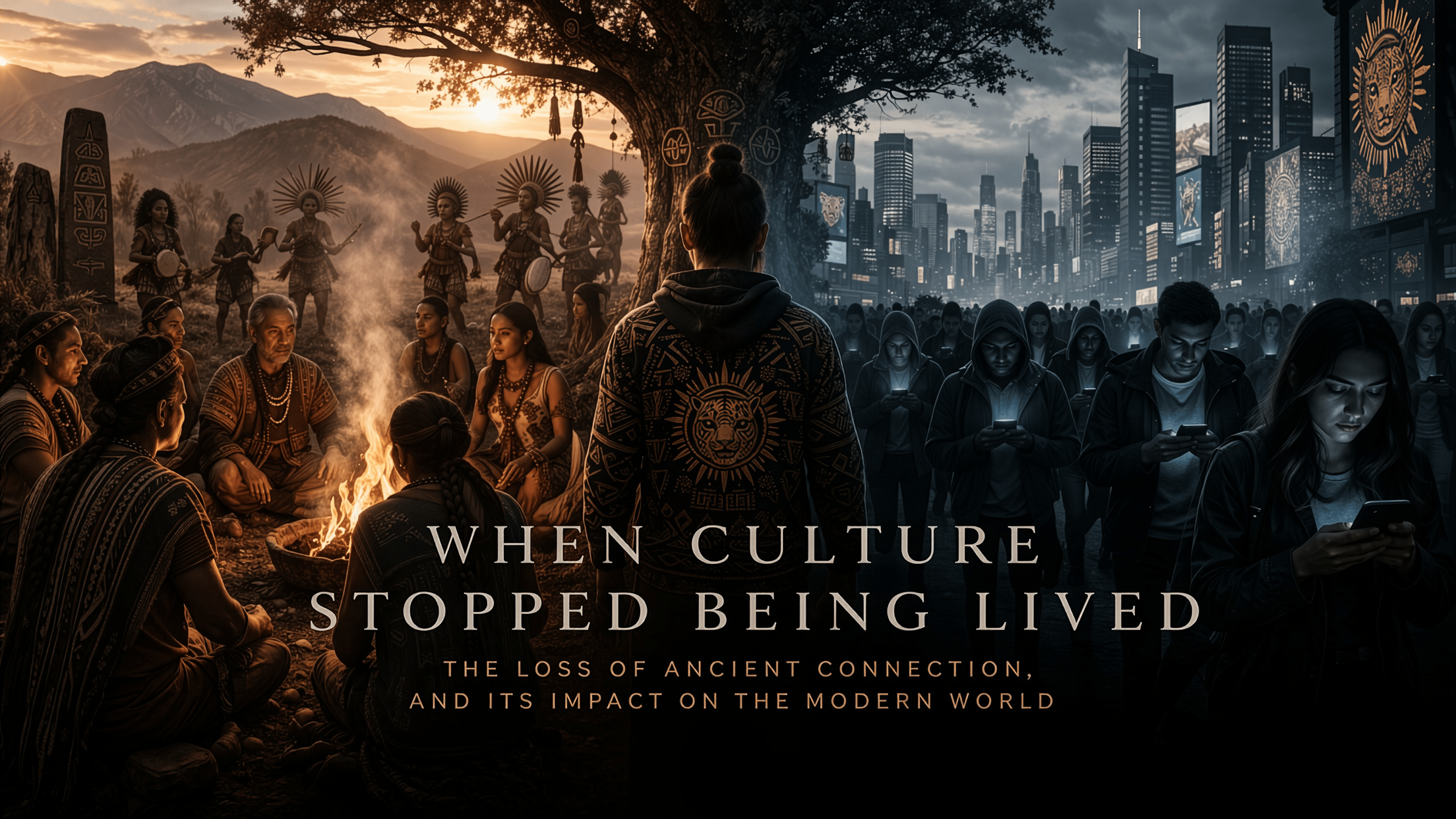
For most of human history, culture was not a hobby.
It was the structure of daily life.
It told people who they were, where they belonged, what they owed their community, and what their suffering meant. It shaped how they dressed, worked, celebrated, mourned, and passed knowledge forward. Culture was not identity decoration. It was identity itself.
Then something changed.
Across the modern world, participation in shared rituals, civic groups, and communal institutions declined sharply after the mid-20th century. Researchers describe this shift as the collapse of “social capital,” the networks of trust and belonging that hold societies together. Harvard political scientist Robert D. Putnam documented that civic engagement in the United States peaked in the 1950s and has steadily fallen since then.
The result is not just cultural change.
It is psychological change.
And possibly civilizational change.
Culture Was Once Infrastructure, Not Expression
Traditional societies did not ask individuals to invent themselves from scratch.
Identity came through:
family lineage
craft traditions
religious rhythms
seasonal festivals
local myths
shared ceremonies
These were not optional experiences. They formed the architecture of meaning.
Anthropologists often describe culture as the system through which communities transmit memory and purpose across generations. When that system weakens, individuals are forced to replace inherited meaning with constructed meaning.
That sounds liberating.
It is also destabilizing.
The Collapse of Social Capital Changed Everyday Life
Putnam’s research showed that Americans gradually withdrew from organizations that once structured communal life:
religious groups
labor unions
parent-teacher associations
civic clubs
veterans’ organizations
neighborhood associations
Participation in many of these institutions fell dramatically after the 1960s.
Even informal social interaction declined. In the 1970s, the average American entertained friends at home about fifteen times per year. That number dropped substantially in later decades.
At the same time, weekly church attendance fell from roughly 48 percent in the late 1950s to around 41 percent by the early 1970s and continued trending downward afterward.
These were not isolated changes.
They were structural signals.
Something fundamental was shifting in how people related to each other.
Industrial Modernity Replaced Belonging With Mobility
For most of history, culture was tied to place.
People lived where their grandparents lived.
Worked within inherited trades.
Shared rituals with neighbors they would know their entire lives.
Industrialization changed this.
Cities expanded. Work became specialized. Families became mobile. Communities became temporary.
Instead of inheriting identity, people began assembling identity.
This transition produced freedom, opportunity, and economic growth.
It also weakened the cultural continuity that had anchored human life for thousands of years.
Technology Individualized Leisure
Another major shift came from entertainment technology.
Putnam estimated that roughly 25 percent of the decline in civic engagement after 1965 could be linked to electronic entertainment such as television, which replaced group participation with private consumption.
Later digital platforms extended that pattern.
Instead of gathering in public squares, people gathered around screens.
Instead of participating in culture, they observed culture.
Instead of inheriting meaning, they curated it.
The Disappearance of Ritual Created Invisible Emptiness
Traditional cultures marked life with shared transitions:
coming-of-age ceremonies
seasonal festivals
collective mourning
initiation into adulthood
community celebrations
Modern societies replaced many of these with institutional milestones:
graduation
career advancement
relocation
individual achievement
These are important events.
But they are not communal transformations.
Humans evolved expecting symbolic passage through life stages. When those passages disappear, meaning does not disappear with them. It relocates.
Often into substitutes.
Fitness communities
political tribes
online identities
consumer brands
These become modern ritual spaces.
Loneliness Is Not an Accident of Personality
Many people assume isolation is a personal failure.
Research suggests something else.
The decline of civic organizations, local associations, religious participation, and neighborhood interaction reflects a broad erosion of social capital, not individual weakness.
Studies linking community participation to health outcomes show that strong social networks improve well-being and even life expectancy.
Social connection is not optional decoration for human life.
It is structural support.
When those structures weaken, loneliness spreads.
Globalization Connected the World While Loosening Roots
Modern communication allows people to experience cultures everywhere instantly.
Music travels globally.
Clothing styles cross continents.
Symbols move faster than language.
Yet belonging does not travel as easily.
Instead of living inside a single cultural framework, many people now move between fragments of many.
This produces creative freedom.
It can also produce identity fatigue.
Without shared rituals, culture becomes aesthetic rather than lived reality.
Culture Shifted From Practice to Performance
Before modern media, culture existed primarily through participation.
Today it often exists through observation.
Festivals become spectacles.
Traditions become content.
Heritage becomes branding.
The transformation is subtle but powerful.
When culture becomes something people watch instead of something they enact, it stops functioning as social glue.
When social glue weakens, communities fragment.
Reintroducing Culture Into Daily Life Matters Again
The decline of shared cultural structure does not mean tradition disappeared.
It means tradition changed form.
Across the world, people are searching for ways to reconnect with ancestry, symbolism, craft, language, and ritual. Not as nostalgia, but as orientation.
Because culture answers questions modern systems rarely address:
Where do I belong?
What connects me to others?
What connects me to history?
These are not abstract questions.
They shape identity.
They shape community.
They shape the future.
Jaguar Sol and the Return of Cultural Presence
Modern isolation did not appear overnight.
It followed the gradual erosion of lived cultural structure.
Reintroducing cultural meaning into everyday objects is one way people rebuild connection to something older than algorithms and faster than trends.
Symbols carry memory.
Patterns carry lineage.
Stories carry identity.
Culture does not return all at once.
It returns piece by piece.
Sometimes stitched into what we wear.
Comments