
FI-CC-00100 | Albert Einstein Iconic Jaguar Portrait
Some figures transcend their own era and become symbols of human curiosity itself. Albert Einstein is one of them. More than a physicist, he became a cultural archetype. The wild hair, the playful irreverence, the refusal to separate imagination from intellect. This piece reinterprets that legacy through the Jaguar Sol lens, transforming one of history’s most recognizable minds into a mythic visual language rooted in symbolism rather than literal portraiture.
The design centers on the fusion of Einstein with the jaguar, a recurring emblem within Jaguar Sol mythology. The jaguar has long represented perception beyond the visible world. In Mesoamerican cultures such as the Maya and Aztec civilizations, the jaguar symbolized power, night vision, and the ability to move between worlds. By merging Einstein’s likeness with the jaguar’s primal awareness, the portrait reframes intelligence not as sterile academia, but as instinct sharpened into discovery. It suggests that true insight comes from the tension between logic and intuition.
Einstein himself embodied this duality. Born in 1879 in Ulm, Germany, he reshaped modern physics with theories that fundamentally altered humanity’s understanding of reality. His 1905 “annus mirabilis” papers introduced special relativity, explained the photoelectric effect, and laid foundations for quantum theory. A decade later, general relativity redefined gravity as the curvature of spacetime itself. Yet despite the mathematical depth of his work, Einstein consistently spoke about imagination as the core of discovery, famously emphasizing that creativity often precedes formal reasoning. This philosophy is central to the piece’s reinterpretation.
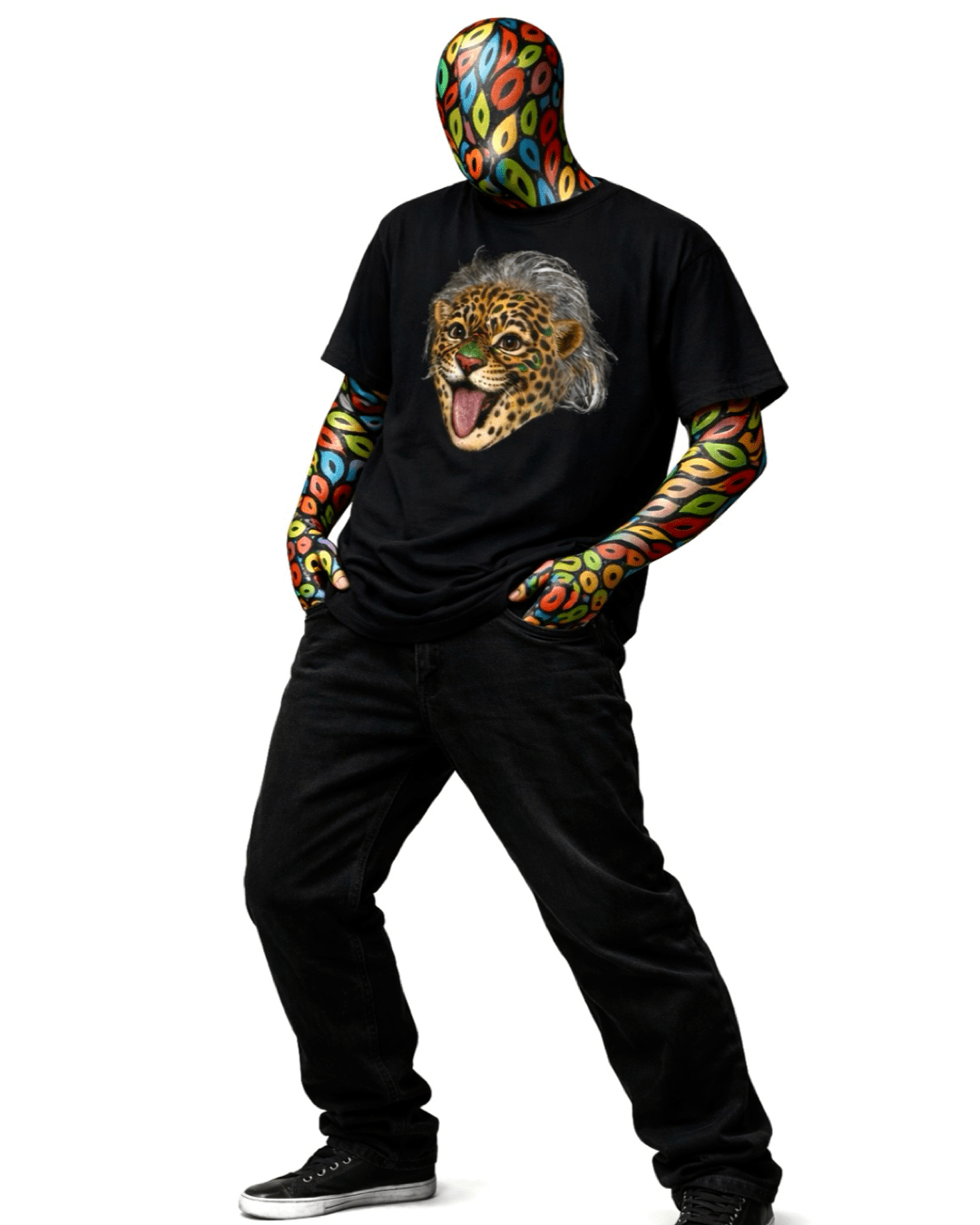
The portrait draws directly from the most iconic image associated with Einstein’s cultural legacy: the 1951 photograph taken on his 72nd birthday, where he sticks out his tongue at photographers. That moment, widely reproduced across the world, shattered the stereotype of the distant genius and replaced it with something human and rebellious. It turned Einstein into a pop-cultural symbol long before the age of internet virality. The Jaguar Sol rendering preserves that irreverence, but reframes it through a mythic lens. The expression remains playful, but the medium transforms it into something almost ceremonial, like a mask worn by a cultural trickster.
The swirling hair in the portrait is intentionally preserved as a defining visual anchor. Historically, Einstein’s untamed hair became shorthand for intellectual freedom and resistance to conformity. In the Jaguar reinterpretation, it becomes more than a physical trait. It echoes solar flares, electrical arcs, and the visual chaos often used to depict the birth of ideas. The jaguar’s fur pattern replaces conventional skin tones, creating a layered symbolism where natural pattern meets intellectual abstraction. It reflects a broader Jaguar Sol philosophy: pattern as memory, texture as encoded story.
This fusion also connects to a larger tradition of transforming historical figures into symbolic archetypes. Cultures across time have reimagined thinkers as mythic forms to preserve their meaning beyond biography. Ancient civilizations turned philosophers into legends. Renaissance art elevated scientists into allegorical figures. The Jaguar Sol approach continues that lineage, translating Einstein into a cross-cultural visual language that blends Mesoamerican symbolism, modern streetwear aesthetics, and archival storytelling.
Importantly, Einstein’s cultural impact extended far beyond physics. He became a global advocate for civil rights, pacifism, and international cooperation, especially after emigrating to the United States in 1933 to escape Nazi persecution. His voice carried moral weight because it bridged intellect and humanity. That broader legacy informs the emotional tone of the design. This is not a sterile scientific tribute. It is a reflection on curiosity as a universal human trait, one that crosses borders, languages, and disciplines.
Within the context of Jaguar Sol’s broader archive, this piece sits at the intersection of intellect and instinct. Many historical portrayals reduce figures like Einstein to simplified icons. This design does the opposite. It complicates the image by layering cultural symbolism onto a universally recognized face. The jaguar does not replace Einstein. It reframes him. The result is a portrait that exists somewhere between historical memory and modern mythmaking.
The garment itself follows the Jaguar Sol archival philosophy: wearable artifacts rather than seasonal graphics. The composition is intentionally centered and unfragmented, allowing the portrait to function almost like a relic or emblem. It invites close viewing. From a distance, it reads as instantly recognizable. Up close, the layered textures and symbolic transformation reveal themselves gradually, mirroring the way historical understanding deepens over time.
In a cultural moment saturated with disposable imagery, this piece leans in the opposite direction. It asks a slower question. What happens when we stop treating historical figures as flat icons and instead reinterpret them through deeper symbolic frameworks? The Einstein Jaguar Portrait offers one answer. It suggests that legacy is not static. It evolves as each generation reimagines the stories it inherits.
Ultimately, this design is less about Einstein the individual and more about what he represents. Curiosity without borders. Intelligence that refuses confinement. The courage to challenge consensus. Through the Jaguar Sol mythology, that spirit is given a new body, one rooted in ancient symbolism and modern expression. A reminder that knowledge, like the jaguar, moves quietly but leaves a lasting imprint.


Comments